'%20fill='%23ccc'/%3e%3c/svg%3e)


What Are Tax-Advantaged Accounts?
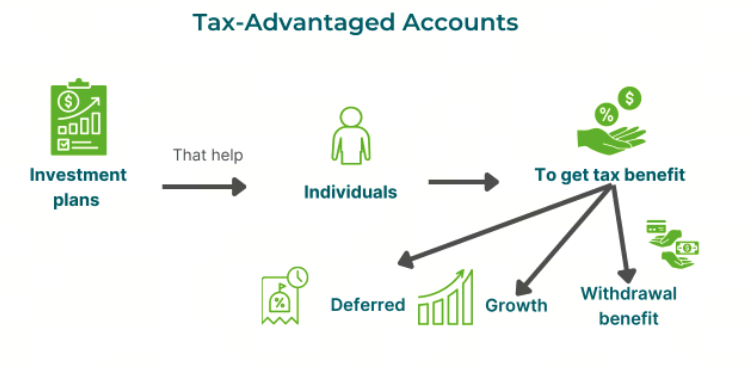
Tax-advantaged accounts are specialized financial tools that offer tax benefits to encourage individuals to save for specific goals. These benefits may come in the form of tax deductions, tax-free earnings, or tax-deferred growth.
Types of Tax Benefits
| Tax Benefit | Description |
|---|---|
| Tax Deduction | Reduces taxable income today |
| Tax-Free Earnings | No tax paid on investment growth or withdrawals |
| Tax-Deferred Growth | Taxes are delayed until you withdraw funds |
Popular Types of Tax-Advantaged Accounts in 2025
In 2025, the most commonly used tax-advantaged accounts include:
401(k) Plans
A 401(k) is an employer-sponsored retirement savings plan. Contributions are made pre-tax, reducing your taxable income, and grow tax-deferred until withdrawal.
Key 2025 Update: The contribution limit has increased to $23,000 for individuals under 50, and $30,000 for those 50 and older.
Roth IRAs
A Roth IRA allows you to contribute after-tax dollars, but your earnings and qualified withdrawals are completely tax-free.
Important Note: In 2025, the income eligibility for a full Roth IRA contribution starts to phase out at $150,000 for individuals and $230,000 for married couples filing jointly.
Health Savings Accounts (HSAs)
Health Savings Accounts offer triple tax benefits: contributions are tax-deductible, earnings grow tax-free, and withdrawals for qualified healthcare expenses are also tax-free.
Chart: 2025 HSA Contribution Limits
| Type of Coverage | Contribution Limit |
|---|---|
| Individual | $4,300 |
| Family | $8,600 |
| Catch-Up (55+) | Additional $1,000 |
529 Plans
529 plans help you save for education expenses with tax-free earnings and tax-free withdrawals when used for qualifying education costs.
New for 2025: Some states are offering additional matching grants for low- and moderate-income families.
Why Tax-Advantaged Accounts Matter More in 2025
The U.S. economy in 2025 is facing higher interest rates and potential tax law changes, making it even more critical to maximize every possible tax advantage. Here’s why:
- Protect against rising taxes by locking in today's tax breaks.
- Boost long-term growth through compounding without annual tax drag.
- Enhance financial security in retirement, healthcare, and education planning.
How to Maximize Your Tax-Advantaged Accounts
If you want to make the most of your tax-advantaged accounts, follow these expert tips:
- Max out contributions whenever possible, especially in 401(k) and HSA accounts.
- Diversify across account types, balancing taxable, tax-deferred, and tax-free buckets.
- Monitor income limits for Roth IRA eligibility annually.
- Take advantage of employer matching programs in 401(k) plans — it’s free money!
Final Thoughts: Start Now, Save Smarter
Tax-advantaged accounts are not just for the wealthy — they are essential tools for anyone serious about building a strong financial future in the United States. In 2025, with potential tax increases looming, taking full advantage of these accounts could mean the difference between just getting by and truly thriving.
Act today, and let tax-advantaged accounts work for you.